Ring of Invisibility
Vainqueur the DragonThe Ring of Invisibility is a dragon-sized magical item given by Victor Dalton to Vainqueur Knightsbane as a gift of reconciliation. More than a tool for concealment, it marks the repair of the master-and-vassal relationship between them, rewards that renewed bond through the Class System, and gives Vainqueur a means of turning his immense physical presence into an unpredictable tactical advantage.
Gift and Reconciliation
The ring first appears during a dispute in which Vainqueur mistakes it for a necklace and suspects another scheme against him. Victor Dalton corrects him by explaining that it is a ring intended for Vainqueur, then reveals that he had commissioned a local blacksmith to make it after sending the Kobold Rangers on an errand. The blacksmith accepted the protection of Vainqueur Knightsbane in place of payment, linking the object to the dragon’s authority even before it reaches his claw.
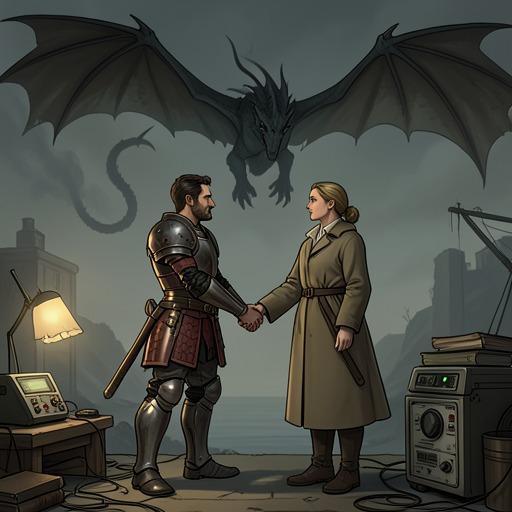
Victor presents the gift hesitantly, admitting that he hopes not to regret offering it. Vainqueur, whose greed quickly overcomes his suspicion, accepts the explanation and demands the ring. Under the twilight sun, Victor places it on his master’s left fourth finger while the minions applaud and the wyvern sulks nearby. The staging makes the item simultaneously magical equipment, a peace offering, and a public confirmation that the trusted vassal has regained his master’s favor.
The narrative explicitly identifies the ring as Vainqueur’s first magical item. Its acquisition therefore carries a personal novelty that exceeds its immediate utility: the dragon receives not merely another possession for his hoard, but an object selected and prepared specifically for his enormous body. The gift also reverses the emotional direction of the quarrel. Suspicion gives way to acceptance, and the restored relationship produces a measurable reward: Vainqueur gains two levels in Noble, receives increases to health, spirit, strength, skill, agility, intelligence, charisma, and luck, and acquires the Noblesse Oblige Perk.
Operation and First Demonstration
The Ring of Invisibility has a deliberately simple mechanism. While wearing it, Vainqueur need only say “blink” to become invisible. Victor begins explaining the procedure, but Vainqueur immediately repeats the activation word before the instruction is complete. His scales turn transparent, and he reacts with surprise because he cannot see himself. Victor confirms that the disappearance has worked while the Kobold Rangers pet the wyvern in the background.
The scene gives the ring a comic contradiction. Vainqueur’s identity is built around being visibly magnificent, and he objects that there should be no reason to hide when he is perfect as he appears. Yet the ring’s power is valuable precisely because it suspends that conspicuousness. The dragon’s first response is vanity, but the story quickly converts the same object into an extension of his strategic intelligence.
The item’s reward is also formally defined. Noblesse Oblige grants Vainqueur a temporary boost to all statistics when he defends his vassals from outsiders. The ring is therefore introduced alongside a rule that translates loyalty into power. Victor’s private act of reconciliation becomes a public strengthening of Vainqueur’s capacity to protect and command his minions.
Tactical Use by Vainqueur Knightsbane
Vainqueur later adopts the ring as part of what he calls solving problems “the dragon way.” During an assault on a castle, he refuses to follow the route taken by Chocolatine’s brother because doing so would mean accepting Furibon’s rules and behaving like a manling. He disables Spell Purge so that the ability can be saved for later, then activates the ring and disappears before confronting the obstacle.
Invisibility does not replace Vainqueur’s characteristic strength; it prepares that strength for a more damaging surprise. Once concealed, he charges directly through the wall rather than choosing between the available doors. His power collapses sections of the ceiling, destroys successive walls, crushes fiends and skeletal warriors, and allows him to continue while proudly redesigning the castle that will one day be his. The ring thus changes the timing and direction of brute force rather than eliminating it. Concealment creates the opening, and overwhelming physical violence supplies the result.
The same method appears during Vainqueur’s flight across the desert. Victor insists that he use the ring, leaving Vainqueur invisible while the dragon carries his chief of staff in one hand and a large goatskin bag for princesses in the other. Victor explains that Brandon Maure would otherwise have them shot on sight and that his Cowl of the Reaper provides additional camouflage, making light travel and concealment necessary. Vainqueur remains bored and questions why he should care whether the fiend notices him, but the ring allows the pair to approach without immediately exposing their presence.
Ambush and Consequences
The ring becomes decisive in Vainqueur’s confrontation with Brandon Maure. After brute strength fails, Vainqueur combines Spell Purge with the ring’s invisibility while a cloud still conceals him. Despite itching and pain, he catches up to the Iron Eagle and flies discreetly above its back. Maure, believing Vainqueur dead, orders further bombardment of the ground and an ugly village below. The concealment therefore creates a dangerous interval in which the enemy acts on false information.
Vainqueur breaks that interval with a surprise attack. He shouts “SURPRISE ATTACK!” and blasts Maure with a fireball, destroying much of the flying fortress’s back and throwing the Demon King onto the bird’s left wing, where half of his body is burned to a crisp. The ring’s importance lies not in invisibility as passive escape but in the transition from unseen approach to sudden violence. It lets Vainqueur turn an apparent defeat into an offensive reversal.
Across these uses, the Ring of Invisibility develops from a reconciliation gift into a recurring emblem of Vainqueur’s hybrid method. It enables stealth without making him subtle in spirit: he remains greedy, proud, destructive, and theatrically direct. The object gives that personality a new tactical grammar, allowing the most conspicuous creature in the scene to vanish, reposition himself, and reappear at the moment when his enemies are least prepared.